Nordiskt Havsforskarmötet 2026
Abstract submission har öppnat. Deadline 15 September 2026. Skicka in här.
Gå till anmälningsformulär här.
Starkare tillsammans – nordiska marina vetenskaper under Ocean Decenniet
Tid: 24 – 26 November 2026
Plats: Aula Magna, Stockholms Universitet
Svenska Havsforskningsföreningen och Norsk Havsforskerföreningen välkomnar alla som är engagerade och intresserade av marina vetenskaper, förvaltning och miljöövervakning till denna konferens om HAVET ! Mötet fokuserar på aktuella aspekter av forskning, förvaltning och miljöövervakning i marina system. Utöver muntliga presentationer och posterpresentationer kommer det finnas utrymme för nätverkande och kontaktskapande.
Abstract submission stängdes den 15 September 2026. Registrera dig till 15 October 2026.
Vi välkomnar abstrakt för såväl muntliga presentationer som posterpresentationer. Inlämningsprocessen hanteras via registreringsportalen nedan. Inkomna bidrag kommer att tematiskt organiseras inom ramen för konferensens sessionsprogram eller, om innehållet bedöms ligga utanför sessionernas ämnesområde, presenteras som fristående inslag (se program nedan). Beroende på antalet inkomna abstrakt (muntliga respektive posterbidrag) kan styrelsen behöva göra en prioritering. Abstrakt från studenter på avancerad nivå (master) och forskarnivå (doktorand), liksom från forskare i början av sin akademiska karriär (postdoktorer), kommer att ges särskild prioritet. Besked om antagning lämnas senast den 31 oktober.
Generella riktlinjer
Abstract: 2000 tecken inklusive mellanslag
Presentation: 12 min + 3 min för frågor och diskussion, för gästtalare 25 min + 5 min
Poster: Storlek A0 (841 x 1189 mm)
Gästtalare

Professor Lars Henrik Smedrud
Geophysical Institute, Bjerknes Centre for Climate Research, University of Bergen
Fjord to the People: Restoring and Reconnecting an Urban Fjord in Bergen, Norway
Bergen ocean city has a 20 m deep fjord as its heart – Store Lungegårdsvann. The inter-generational project Fjord to the People seeks to restore public engagement with this urban marine environment through collaboration between University of Bergen, the Municipality of Bergen, research institutes, local schools, the public Bergen Aquarium and Science Centre and private actors. The project aims to increase understanding and communication about the local fjord following decades of pollution and limited recreational use. Regular fieldwork in Store Lungegårdsvann has supported education in biodiversity, sustainability and oceanography. The Real Data measuring station provides a daily top-to-bottom series of temperature, salinity, oxygen, fluorescence, and turbidity, linking real-world observations with scientific techniques over time. Recent restoration efforts by the Municipality of Bergen, conducted through the Cleaner Harbour initiative, have included major reductions in sewage discharges and capping of contaminated sediments. Additional measures are being implemented to improve water circulation by redirecting freshwater inputs to deeper (denser and saltier) layers. However, precipitation-fed runoff from urban hills and mountains continues to introduce fecal bacteria, heavy metals, plastics, and flame-retardant compounds, affecting ecosystem health. Current activities include habitat enhancement using “green gravel,” acoustic tagging of migratory fish, surveillance of pollutants in sediments and fish, public dissemination of near-real-time water-column observations, AI-assisted photographic monitoring, and science communication through films and conferences. The fjord will onwards become a living laboratory where environmental restoration, research, education and public engagement are brought together, demonstrating how urban waters can be both rehabilitated and reconnected with the public.

Dr. Laura Tuomi
Finnish Meteorological Institute
Evolving marine observing and forecasting systems to increase our understanding of changing marine environment
The coastal seas are experiencing significant changes. In addition to the impacts of climate change and human pressures, the changing geopolitical landscape is introducing new challenges for maritime safety, critical infrastructure, and environmental monitoring. This presentation explores how marine observing and forecasting systems need to evolve to remain reliable and fit for purpose in an increasingly complex environment. It highlights the opportunities offered by new autonomous observing technologies to deepen our understanding of key physical and biogeochemical processes that affect the environmental state of the coastal seas. Particular attention will be given to integrated observing networks and new developments in forecasting, including AI and data-driven approaches. The importance of strengthened collaboration across disciplines, sectors, and national boundaries will also be discussed.

Professor Adam Martiny
Section for Ocean and technology, DTU Aqua, Denmark
From Genes to Global Biogeochemistry: Insights from Bio-GO-SHIP
GO-SHIP provides a global framework for repeat, high-quality observations of ocean physics and biogeochemistry, creating a unique record of how the ocean is changing. Bio-GO-SHIP extends this framework to marine ecosystems by adding coordinated measurements of microbial communities, genomic diversity, and biological function. In this keynote, I will show how phytoplankton adaptation can be used as a sensitive sensor of environmental change. By linking genomic and physiological signatures of nutrient stress to hydrography and biogeochemical conditions, we can reveal how organisms experience a changing ocean. These biological responses also provide new insight into the processes regulating carbon and nutrient cycles. Together, Bio-GO-SHIP connects ocean change, biological adaptation, and global biogeochemistry.

Associate Professor Lena van Giesen
Department of Biology, NTNU, Norway
Do what you can where you are with what you have- insights from cnidarian wisdom.
Navigating through marine environments, a vast and dynamic world full of complex information necessitates elaborate sense organs, capable of filtering and encoding relevant signals, and sophisticated motor output for appropriate responses. Being sessile, adult corals and anemones are exposed to changing environments without the means to relocate. Species dispersal is therefore restricted to the developmentally restricted larval life stage, during which animals are motile. However, how microscopic cnidarian larvae achieve reliable dispersal and conquest of novel habitats under time pressure and unpredictable environmental conditions is largely unknown. Recent findings from serval lines of research, including our lab, are beginning to illuminate the astonishing mechanisms that have evolved in order to make this endeavor successful for the last ≈550 million years.

Dr. Maria Mancilla Garcia, Stockholm Resilience Centre, Stockholm University
Contested Coastlines: How Conflicting Narratives and Institutional Friction Drive Social-Ecological Feedbacks

Dr. Leon Chafik
Department of Meteorology, Stockholm University
What’s up with the AMOC? What three decades of direct observations tell us about its state.
Whether the AMOC is weakening remains one of the most debated questions in climate science, yet much of the evidence for a decline is indirect, resting on surface temperature fingerprints and paleoceanographic reconstructions. Direct transport measurements exist at only a few latitudes and mostly span two decades or less. The Greenland–Scotland Ridge is an exception. The warm Atlantic inflow to the Nordic Seas and the dense overflow returning southward have both been monitored for close to three decades, spanning a period of pronounced hydrographic change. In this talk I revisit these records to show how they capture the AMOC’s branches, what they reveal, and what this means for the wider debate about an AMOC decline.

Professor Christoph Humborg
and Professor Alf Norkko
Baltic Sea Science Centre, Stockholm University and Tvärminne Zoological Station, University of Helsinki
Beyond blue carbon: biodiversity and ecosystem state regulate coastal climate feedbacks
Coastal ecosystems are promoted as climate solutions because they capture and store ”blue carbon”. This is important, but stocks and burial rates alone do not reveal net cooling. Carbon may be retained, remineralised, exported or resuspended, while CH4, N2O and other short-lived climate forcers such as volatile organic carbon add pathways often omitted from assessment. Their balance varies with ecosystem condition, disturbance, and recovery. Drawing on the CoastClim perspective, we reframe coastal ecosystems as state-dependent climate regulators. We argue that ecosystem state, rather than habitat identity alone, should be the central unit of coastal climate assessment. Biodiversity should be treated as a mechanism, not simply as a co-benefit. Species composition, functional traits, body-size structure, trophic organisation and microbial communities influence carbon turnover, sediment oxygenation, redox conditions, methane production and oxidation, and recovery. These controls are especially relevant in Nordic coastal systems, where seasonality, eutrophication, hypoxia, heatwaves and storms can cause large shifts in climate-relevant processes.
As a case study of this CH4 pathway, we draw on continuous sea–air CH4 flux observations collected over 15 years across the Baltic Sea. Emissions are highest, and most undersampled, in shallow nearshore waters, declining with depth and distance from shore to reveal a characteristic CH4 compensation boundary beyond which coastal waters shift from net sources to weaker emitters or sinks. Set against the broader coastal carbon budget and upscaled to national territorial waters, these fluxes are large enough to warrant inclusion in national greenhouse-gas inventories and climate reporting frameworks.
We propose a BIO–GEO–GHG/SLCF framework linking biological structure with sediment biogeochemistry, greenhouse-gas exchange and short-lived climate forcers. It extends assessment across vegetated habitats, non-vegetated sediments, pelagic realm and depositional basins as connected seascapes. Moving from habitat inventories to ecosystem-state trajectories can improve monitoring, restoration evaluation and decision support. The key question is not only where carbon is stored, but where and when coastal ecosystems cool or warm the climate, and how management can shift that balance.
Plats
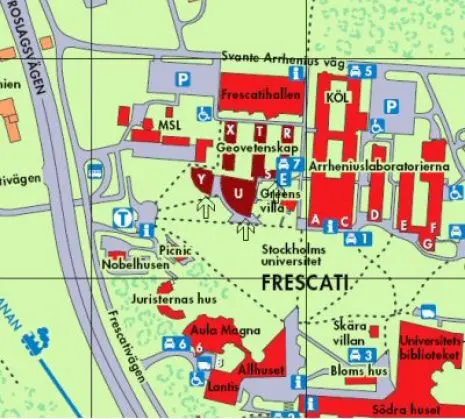
Konferenslokalen är Aula Magna (länk till campuskarta) på Stockholm Universitetets Campus. Utöver keynote-föreläsningar, muntliga presentationer, och posterbidrag kommer det att finnas utrymme för nätverkande under pauserna.
Konferensmiddag
Konferensmiddagen hålls den 25 november. Vi försöker hålla kostnader för middagen så att alla deltagare kan delta. Kostnaderna annonseras under hösten och registreringen till middagen sker separat. Informationen om anmälan till middagen skickas via mail.
Dyrssenpriset
Svenska Havsforskningsföreningen delar årligen ut Dyrssenpriset för de två bästa nominerade examensarbetena i marinvetenskap på masternivå. Förstapriset är 10 000 SEK och andrapriset 5 000 SEK. Priset har instiftats av SHF till minne av David Dyrssen (1922–2011), emeritusprofessor i analytisk kemi vid Göteborgs universitet. Som en av föreningens grundare ägnade han sin karriär åt att aktivt främja tvärvetenskaplig forskning inom marinvetenskap. Prisutdelningen och presentationer av pristagaren äger rum den 25 november.
Årsmöte
Svenska Havsforskningsföreningen är en politiskt obunden och ideell organisation. Föreningens årsmöte hålls den 25 november kl. 15:00 som en del av konferensen. Norska Havsforskerförening kommer också hålla sitt årsmöte vid samma tid på egen plats. För mer information och dokument, se Om oss i huvudmenyn.
Konferensavgift
Registrering till konferensen omfattar tillgång till presentationer och postersessionen. Registrering av svenska deltagare kräver medlemskap i Svenska Havsforskningsföreningen. Deltagare från andra nordiska länder är befriade från avgift, men uppmuntras att vara medlemmar i sin nationella förening för marin havsforskning. Konferensavgiften inkluderar mingel (tisdag), fika och luncher (onsdag och torsdag). Särskild anmälan krävs för konferensmiddagen (onsdag). Konferensavgiften täcker inte resekostnader eller kostnader för boende. Ett begränsat antal konferensbidrag finns tillgängliga för studenter och forskare i början av karriären. Ansökan kan göras för bidrag till resa, boende och konferensavgift, upp till 5 000 SEK. Ersättning för resa och boende och för studenter som deltar med presentation eller poster prioriteras.
Konferensavgift för deltagare från offentliga svenska institutioner: 2500 SEK
Konferensbidrag för utländska deltagare och deltagare från icke-offentliga institutioner och företag är 3125 SEK. Denna avgift är densamma som avgiften för deltagare från svenska offentliga instititioner, men inkluderar den obligatoriska momsen på 25 %.
Varmt välkommen!
Styrelsen Svenska Havsforskningförening och Norsk Havsforskerforening
Vi är tacksamma för stödet från följande institutioner.
Sveriges meteorologiska och hydrologiska institut SMHI
Havs- och vattenmyndigheten HAV
Institutionen för geologiska vetenskaper, Stockholms Universitet